4 clips, 273 notes · Same audio for both · Measured 5 Nov 2026
We tested two audio to MIDI converters on 273 known notes
We wrote four clips note by note, so we knew every right answer, then ran the same audio through AudioForges and Spotify's Basic Pitch. Both found most notes. The difference is the junk: 18 wrong notes from AudioForges, 238 from Basic Pitch.
Overall score, 273 notes
AudioForges High accuracy
94.6%
18 wrong extra notes · YourMT3 plus our pipeline
Spotify Basic Pitch
65.9%
238 wrong extra notes · Default settings
Results
What we measured
| Clip | Real notes | AudioForges | Basic Pitch |
|---|---|---|---|
| Piano chords | 68 | 86.5% · 64 right, 16 extra | 74.1% · 63 right, 39 extra |
| Piano melody | 37 | 98.6% · 36 right, 0 extra | 96.1% · 37 right, 3 extra |
| Piano and bass | 104 | 98.0% · 100 right, 0 extra | 61.3% · 87 right, 93 extra |
| Guitar picking | 64 | 96.1% · 61 right, 2 extra | 55.4% · 64 right, 103 extra |
| All four | 273 | 94.6% · 261 right, 18 extra | 65.9% · 251 right, 238 extra |
Basic Pitch found a few more of the real notes on the melody and guitar clips. It also added far more notes that are not in the recording, and those are the ones you clean up by hand before the MIDI is usable.
Every score above is the MIDI file exactly as you download it, with nothing shifted or cleaned up by hand. Each file also carries the right tempo for its clip. This test first caught a bug on our side, where the piano and bass file started one bar late. That was fixed on 5 November 2026, and all four clips were run again after the fix.
See it
The guitar clip, note by note
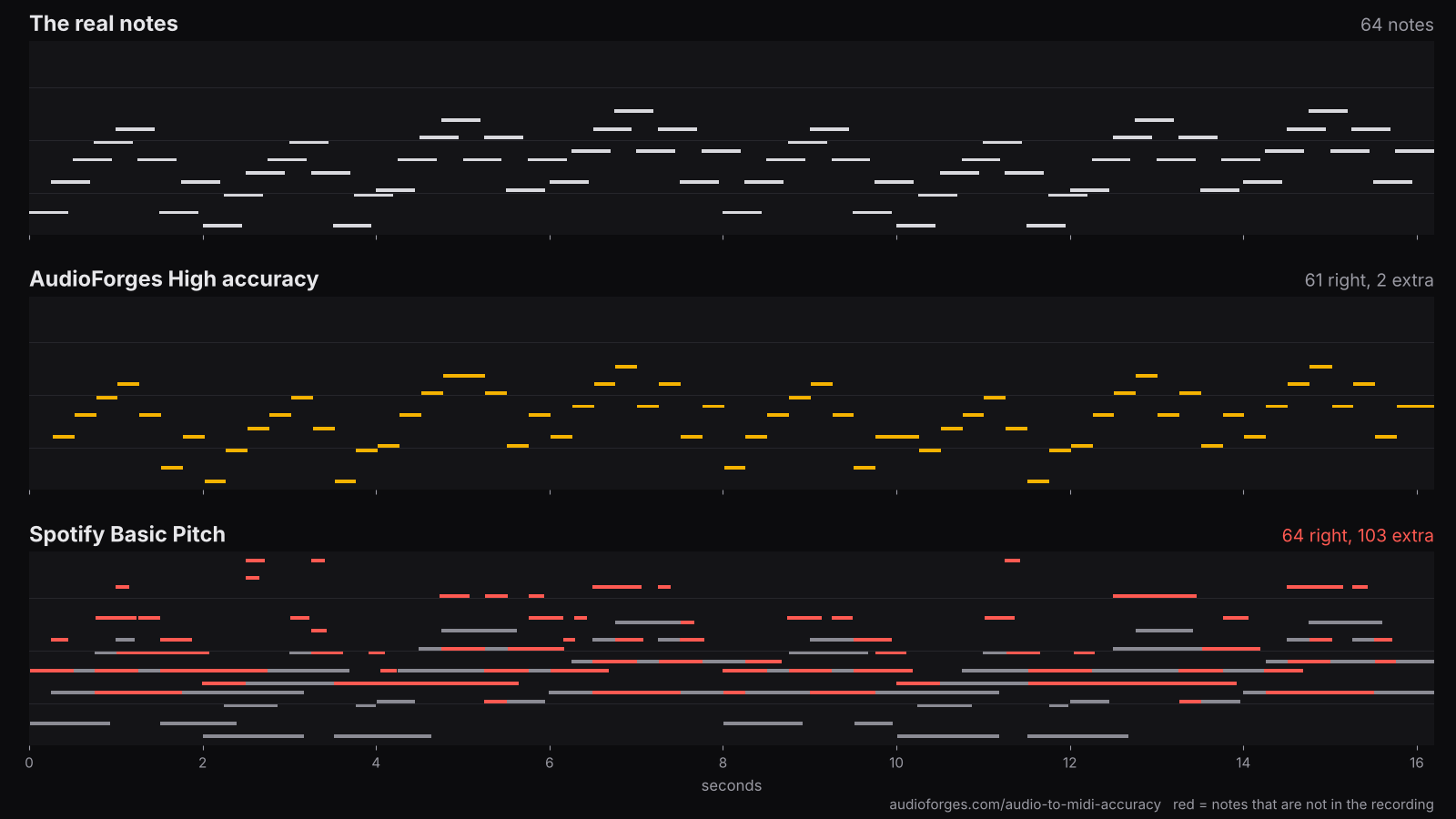
Top: the notes we wrote. Middle: AudioForges, 61 right and 2 extra. Bottom: Basic Pitch, all 64 right plus 103 extra in red, mostly ghost notes above the real ones and long notes chopped in two.
Real loops
Three guitar loops from a sample pack
The scored test uses clips we wrote ourselves, because that is the only way to know every right note. Real recordings are harder, so here are three guitar loops from a sample pack, turned into MIDI and played back against the original audio.
These loops have no answer key, so they are not part of the score above. Listen and judge by ear.
Method
How the test was run
We wrote four clips note by note: piano chords at 96 BPM, a piano melody at 110 BPM, piano with bass at 92 BPM, and steel guitar picking at 120 BPM. Each was rendered to a 44.1 kHz WAV with the free FluidR3 GM sound set. The MIDI we wrote is the answer key.
AudioForges was run on the live site in High accuracy mode, again after the 5 November timing fix. Basic Pitch was run with Spotify's official model at its default settings. Both got the same WAV files, and we dropped nothing from either result.
Scoring uses mir_eval, the standard library for music transcription research. A note is right when its pitch matches and it starts within 50 milliseconds of the real note. Note length is not scored.
Limits: four clips is a small test, and clips rendered from a sound set are cleaner than a real recording, so expect lower numbers from both tools on a busy mix. We will add real recordings to this page as we test them.
Download the four clips with their answer key MIDI files (5.6 MB) and repeat the test with any converter.
Under the hood
What runs inside AudioForges
High accuracy runs YourMT3, a published research model from Queen Mary University of London that writes a separate track for each instrument. We did not train it. Our work is around it: splitting the song into instruments first, preparing the audio, and Forge Roll, where you play the notes against your song and fix any before you download.
The free One track mode runs Spotify's Basic Pitch, so the right column above is also what our free mode gives you. Try audio to MIDI or turn a recording into sheet music.
Frequently asked questions
Of the two we tested on the same 273 known notes, AudioForges High accuracy: an overall score of 94.6% against 65.9% for Basic Pitch. Both found most of the notes. The gap comes from wrong extra notes: 18 from AudioForges, 238 from Basic Pitch. Other tools were not part of this run, so we make no claim about them.
The F1 score, the standard number in music transcription research. It rewards finding the real notes and punishes adding notes that are not there, in one figure. A note counts as right when the pitch matches and it starts within 50 milliseconds of the real note.
No. It found 92% of the notes, more than AudioForges on the melody and guitar clips, and it is free and open. Its weak spot is extra notes: nearly half are overtones, a ghost note an octave or so above a real one, and about a third are real notes chopped in two. Every one is a note you delete by hand.
No. High accuracy runs YourMT3, a published research model from Queen Mary University of London. We did not train it. Our part is the pipeline around it: splitting the song into instruments first, preparing the audio, and the Forge Roll editor where you fix notes before you download.
High accuracy, which costs one song. The free One track mode runs Basic Pitch, so the Basic Pitch column is also what you get from our free mode.
Yes. Download the four clips with their answer key MIDI files below, run them through any converter, and score the result the same way. The scoring method is listed in the method section.